The field player
The mechanics
The field player is a precision machine: a fixed, armless torso, with all the work concentrated below the knees. Here is exactly what you control, and why those constraints produce a technical game.
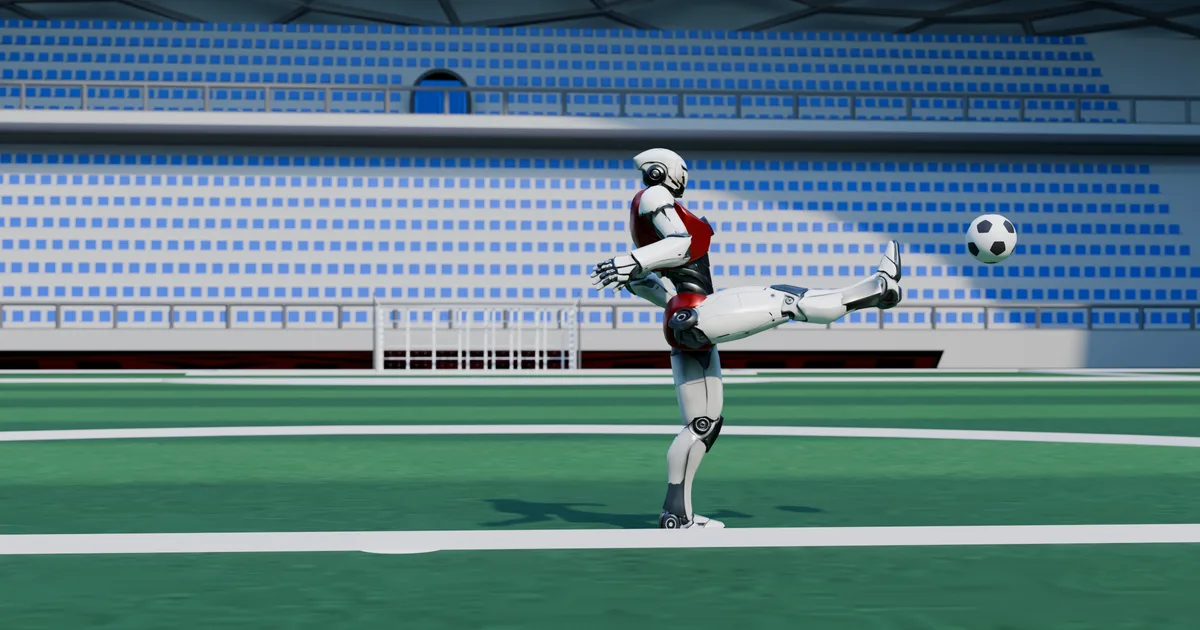
A fixed torso, with no arms
The upper body is a solid block. That choice is not decorative: it removes any way of rescuing a mistake with the hands and forces you to rely on positioning and legs alone.
The joints sit below the knees. The lower leg does all the striking and aiming work, and the mechanical design deliberately leaves the rotation axes visible during a shot.
Moving without ever falling
The torso moves with WASD, continuously. You run, pivot and slide, and the character never falls. Thrusters add a double jump and a dash, as useful for winning an aerial duel as for escaping a press.
The robot’s physics allows what a human body would not: you can run while holding one leg at full extension without losing balance. That freedom is what makes the infinite volley playable.
One command per leg
The torso moves on the keyboard, but the legs are commanded with the mouse: one for the left, one for the right, and only one active at a time. Producing a convincing run or dribble therefore means alternating the rhythm yourself.
No move is pre-recorded. Step-overs, feints, back-heels: nothing is scripted, they are sequences you compose yourself and keep missing until you master them.
The ball’s direction depends on the exact angle of the shin and foot at the instant of contact. There is no aim assist: a sloppy shot goes astray, and a good shot is a gesture you got right.
Infinite volley
Holding one leg command keeps the foot loaded in the air while you keep moving with WASD. The gesture does not fire as long as the command is held.
It works both ways. In attack, load a volley and release it exactly as the ball arrives. In defence, hold the leg out as a barrier in front of an attacker, like a shield.
Header and tackle
- Header
- A dedicated key to strike the ball with the torso or head. Decisive on corners and throw-ins, where the foot does not reach.
- Destabilising tackle
- Standing or sliding, a move aimed at the opponent’s joints. The impact makes the struck robot’s legs slacken or vibrate, and it loses control of the ball without its run being stopped. This is not a foul — see the rules.
What it asks you to learn
A conventional sports game asks you to choose the right action at the right time; here you also have to produce it. The first step is running cleanly by alternating legs, the second is striking where you aimed, the third is chaining both without thinking about it.
That is why the goalkeeper is played with entirely different controls: they are two separate skills.